Scarification: Soak in water, let stand in water for 24 hours
Stratification: cold stratify for 60 days
Germination: sow seed 1/8" inch deep, tamp the soil, keep moist, mulch the seed bed, remove mulch upon germination, requires light for germination
Native to: Alabama, Arkansas, Connecticut, Delaware, District of Columbia, Florida, Georgia, Illinois, Indiana, Iowa, Kansas, Kentucky, Manitoba, Maryland, Massachusetts, Mexico, Michigan, Minnesota, Mississippi, Missouri, Nebraska, New Hampshire, New Jersey, New York, North Carolina, North Dakota, Ohio, Oklahoma, Ontario, Pennsylvania, Québec, South Carolina, South Dakota, Tennessee, Texas, Vermont, Virginia, West Virginia, Wisconsin
Native
Introduced
Menispermum canadenseMenispermum canadense
Common Moonseed, Moonseed, Yellow Parilla
In Stock: 0.267 lb (Total:0.267lb)
Menispermum canadense
select i.*, as2.state_abbr
from inventory_item_manage i
left outer join sheffields_2017.address_states as2 on (as2.state_name = i.CollectionLocale or as2.state_abbr = i.CollectionLocale)
where i.inventory_id = '4438'
group by i.id
Scarification: Soak in water, let stand in water for 24 hours
Stratification: cold stratify for 60 days
Germination: sow seed 1/8" inch deep, tamp the soil, keep moist, mulch the seed bed, remove mulch upon germination, requires light for germination
Native to: Alabama, Arkansas, Connecticut, Delaware, District of Columbia, Florida, Georgia, Illinois, Indiana, Iowa, Kansas, Kentucky, Manitoba, Maryland, Massachusetts, Mexico, Michigan, Minnesota, Mississippi, Missouri, Nebraska, New Hampshire, New Jersey, New York, North Carolina, North Dakota, Ohio, Oklahoma, Ontario, Pennsylvania, Québec, South Carolina, South Dakota, Tennessee, Texas, Vermont, Virginia, West Virginia, Wisconsin
Native
Introduced
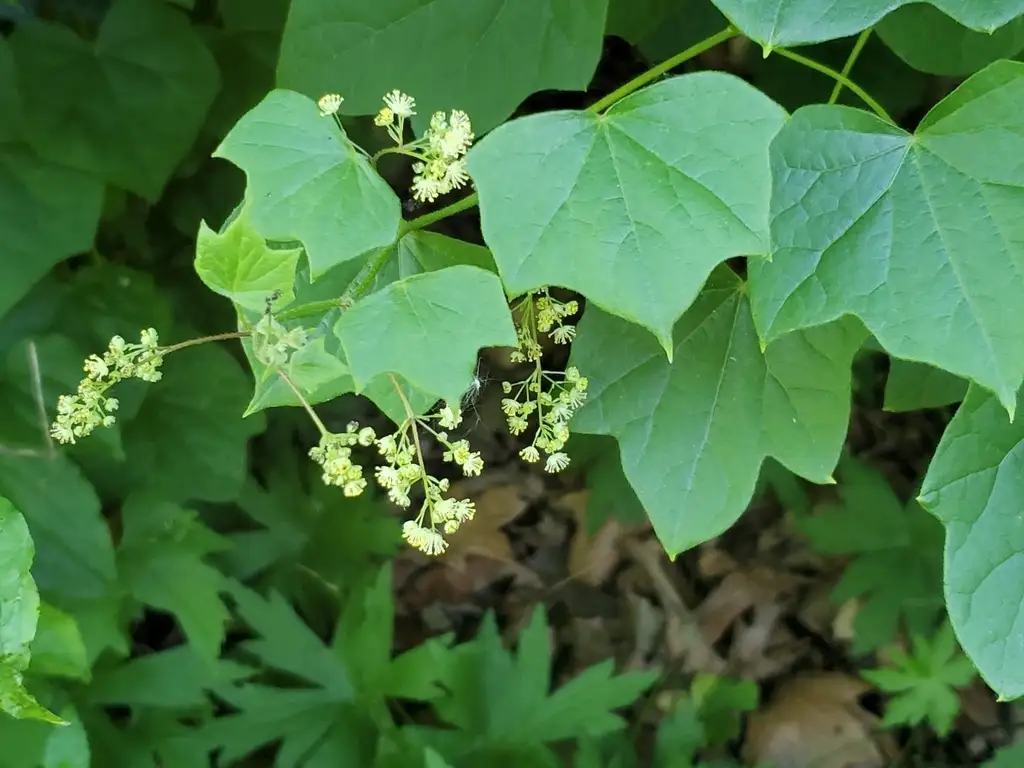
Discover the captivating beauty and ecological value of Common Moonseed (Menispermum canadense), a robust, dioecious vine that embellishes your garden with its twining stems and charming greenish-white blossoms. Reaching up to 25 feet in length, this perennial vine thrives in partial to full shade and prefers medium to wet soil conditions. Ideal for gardens displaying natural woodland aesthetics, Moonseed excels as a pioneer species in areas with a history of disturbance, commonly found in thickets, woodlands, and along tranquil streambanks from Quebec to Mexico.
A vigorous grower, Moonseed spreads swiftly through rhizomes, forming extensive ground cover where no support structures are available. Though its grape-like black fruits are adored by birds, they are highly toxic to mammals and humans, making it crucial to avoid ingestion. With its crescent-shaped seeds and distinctive leaf structure, Moonseed adds a unique visual element to your landscape, while also being deer-resistant.
Handle with caution due to its toxic nature; consider planting in areas less accessible to pets and small children. Maximize its ornamental potential by training it on trellises or arbors for a striking vertical display, or let it spread naturally as a lush ground cover, contributing to soil erosion prevention. Adaptable to USDA Zones 3-8, this fascinating vine is an exceptional choice for habitat restoration projects and naturalized garden settings.